The Cost of Blind Change
Despite decades of frameworks, models, and training programs, 70% of change initiatives still fail to meet their objectives (McKinsey). But why? More often than not, it’s not the strategy that’s flawed—it’s the surprise resistance that derails execution. And the tragedy? That resistance was predictable.
In an era where organizations track everything from customer churn to supply chain delays, it’s time for change leaders to leverage predictive analytics not just as a rear-view mirror—but as a strategic radar.
Welcome to the future of proactive change management.
Why Change Resistance Needs a New Lens
Traditional change management tools rely heavily on surveys, workshops, and leadership intuition. While helpful, these are often static, subjective, and lagging.
Predictive analytics flips this script. It enables organizations to:
- Spot resistance patterns before they escalate
- Forecast adoption trajectories across departments
- Intervene early where sentiment or behavior suggests misalignment
- Quantify change fatigue across project portfolios
In short, it makes the invisible visible—and actionable.
What Is Predictive Analytics in Change Management?
Predictive analytics is the use of historical data, statistical models, machine learning algorithms, and behavioral signals to forecast future outcomes.
In the context of change initiatives, it can:
- Identify which teams or individuals are likely to resist
- Pinpoint drivers of disengagement (e.g., workload spikes, poor communication)
- Reveal early signs of burnout or fatigue
- Track sentiment trends in real time across change touchpoints
It’s not magic. It’s smart correlation and pattern recognition.
The Business Case: Why Now?
Several converging trends make predictive analytics not just useful—but urgent:
- Digital transformation pressure is accelerating; resistance = delay = cost.
- Remote and hybrid work dilute traditional cultural touchpoints.
- AI-powered analytics tools are more accessible than ever.
- Workforce expectations have shifted—employees expect transparency and personalization.
The competitive edge now lies not in managing resistance as it arises, but neutralizing it before it starts.
5 Data-Driven Tactics to Predict Resistance & Drive Adoption
Here are five practical strategies organizations can implement today:
1. Use Historical Project Data to Build Resistance Models
Most organizations have years of internal data from previous transformations—timeline delays, attrition spikes, helpdesk tickets, etc.
By mining past change initiatives, organizations can train models to:
- Predict departments likely to resist based on historical patterns
- Link project types (e.g., tech upgrades, policy shifts) with resistance levels
- Flag critical resistance inflection points
🔍 Tool tip: Platforms like Power BI or Tableau can help visualize patterns. Python libraries (e.g., scikit-learn) can run logistic regression to forecast risk areas.
2. Deploy Sentiment Analysis on Internal Communications
Employee emails, chats, and feedback tools hold valuable (anonymous and ethical) insights. AI-driven sentiment analysis can flag:
- Negative tone shifts after key announcements
- Passive disengagement in team collaboration tools
- Doubt, sarcasm, or anger in open-text surveys
When correlated with team structure, tenure, or function, these insights paint a dynamic map of change readiness.
🔍 Tool tip: Tools like Qualtrics XM, Microsoft Viva, and Culture Amp offer real-time sentiment dashboards.
3. Monitor Behavioral Signals for Early Warning
Beyond words, actions matter. Predictive systems can be trained to observe:
- Drop-offs in training module completions
- Login frequency on new platforms
- Participation in change-related town halls or surveys
- Increase in “shadow IT” or workarounds
These indicators form an early warning system for disengagement.
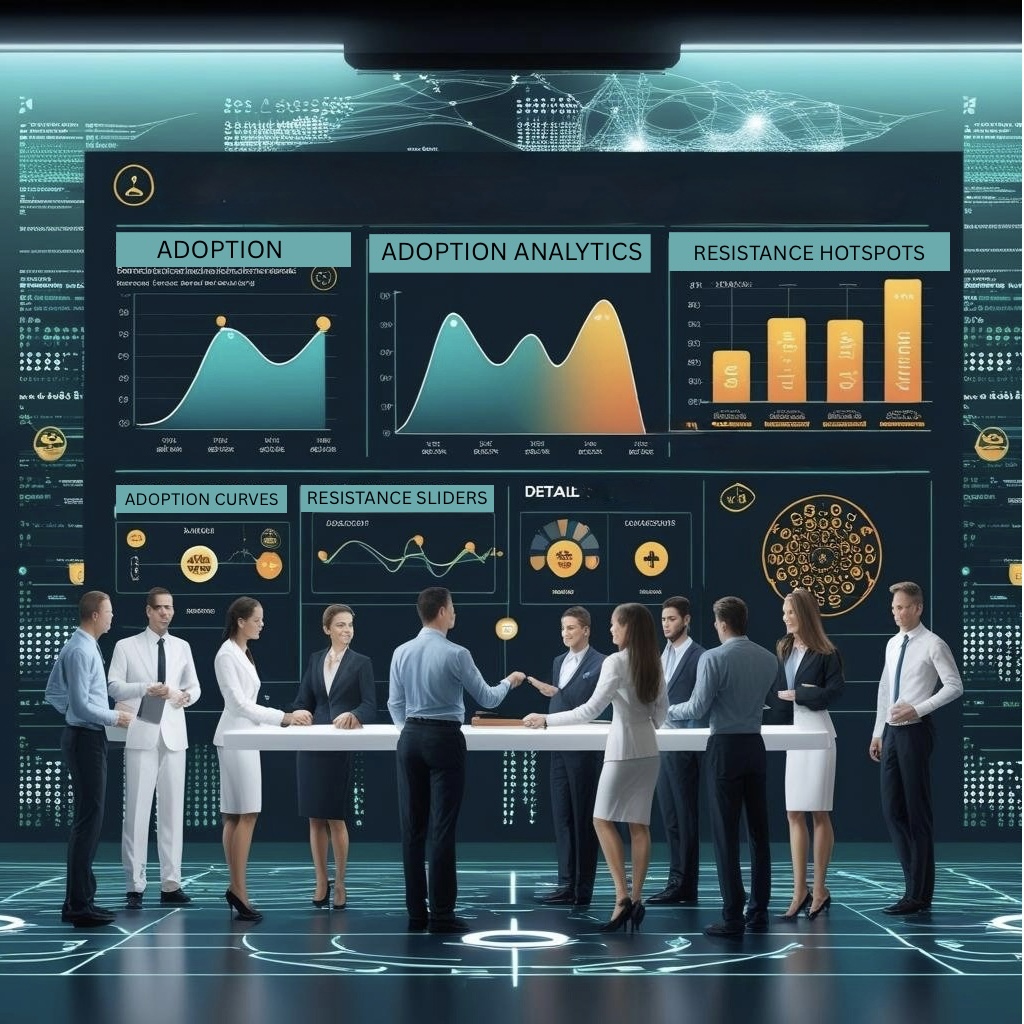
4. Create Dynamic Change Adoption Dashboards
Change shouldn’t be managed in spreadsheets. Real-time, visual dashboards help leaders:
- Track adoption rates by region, role, or business unit
- Benchmark team sentiment against the organizational baseline
- Drill down into high-resistance zones and explore root causes
When integrated with HRIS and communication tools, these dashboards become mission control for change leaders.
5. Simulate Interventions with Scenario Modeling
Not all resistance is equal. Some teams bounce back with coaching. Others may need structural or role clarity.
Using simulation tools, change teams can model:
- What happens if we delay communications by a week?
- How does adding a peer ambassador impact adoption?
- Will adding training reduce friction faster than leadership messages?
This allows for experimentation before escalation—a powerful edge.
Consultant Corner: 4 Quick Wins to Start Today
🔹 Tag Resistance in Your Change Logs: Start logging team behaviors and sentiment manually—even without tools, patterns will emerge.
🔹 Conduct a Post-Mortem Audit: Use past projects to identify where resistance emerged and what indicators preceded it.
🔹 Pilot Predictive Sentiment Surveys: Include open-text responses and use NLP tools (even ChatGPT) to analyze tone.
🔹 Train Change Agents in Data Interpretation: Empower them to read dashboards, not just gut feelings.
From Reactive to Proactive: A Cultural Shift
This isn’t just a tech play—it’s a mindset evolution. Predictive analytics in change doesn’t replace empathy, storytelling, or leadership. It enhances them.
It allows change teams to respond at the speed of human behavior, not the speed of scheduled check-ins.
In an environment where every delay costs time, money, and trust, anticipating resistance is the new gold standard in change leadership.
Case Scenario: Predictive Failure vs. Predictive Power
Company A was rolling out a new CRM system across five countries. They relied solely on periodic surveys. Three weeks post-rollout, resistance in the APAC region caused operational delays and data errors. By the time leadership noticed, it had already cost $2 million in lost sales.
Company B, facing a similar rollout, used predictive analytics. Historical data showed APAC teams were historically hesitant with data tools. Sentiment analysis caught confusion after early training sessions. Interventions (localized training, language adaptation, local champions) were deployed before go-live.
Result: 97% adoption within 60 days, minimal resistance.
The difference? Foresight.
Final Reflection: Predict to Empower, Not Just Control
Change is hard—because people are complex. But people also leave clues. Predictive analytics helps us honor those signals, interpret them with care, and respond with precision.
As organizations move from change projects to change cultures, let data be your compass—not your crutch.
🔄 Are you reading the resistance, or reacting too late?